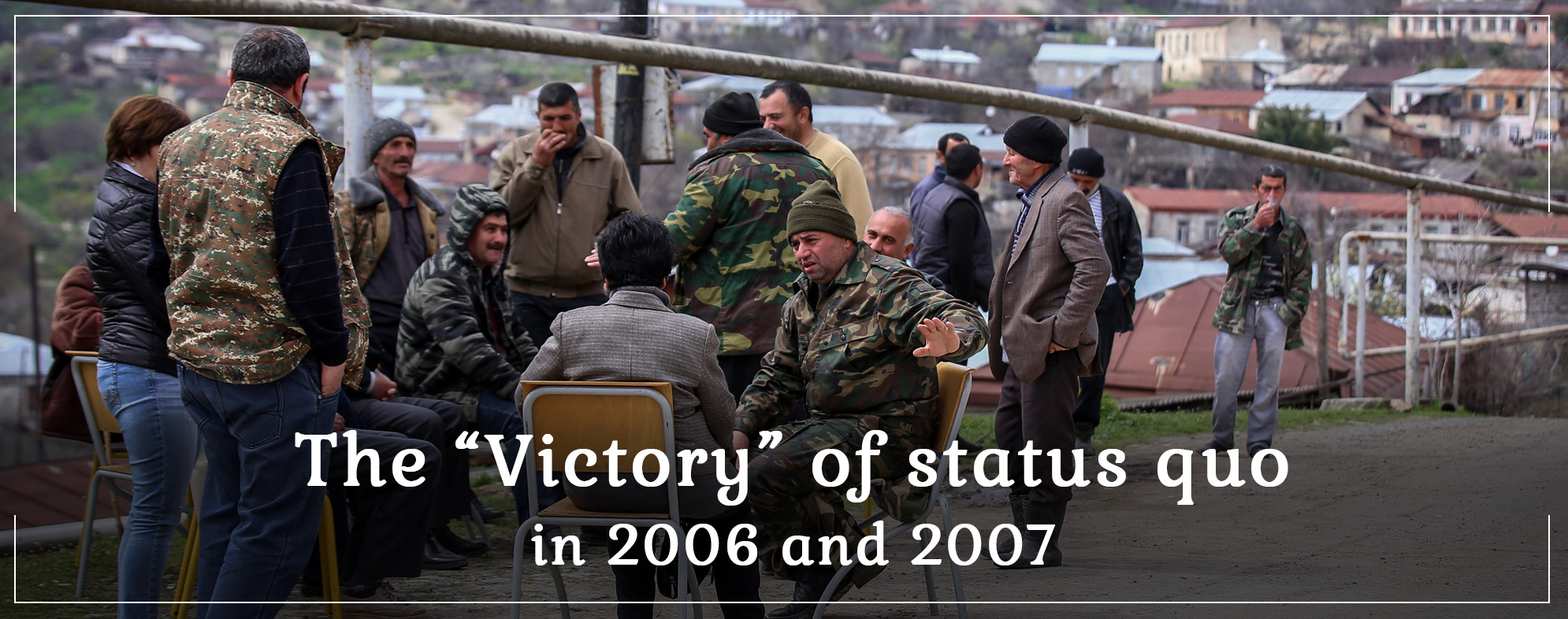
Representatives of the current government accuse their predecessors of failing to make painful compromises over the Karabakh settlement, claiming that war was only a matter of time.
We decided to take a look back at how the public perceived various settlement options 20 years ago.
In early February 2006, about a week before the start of talks between Armenian and Azerbaijani presidents Robert Kocharyan and Ilham Aliyev in Rambouillet, experts from the Yerevan-based International Center for Human Development (ICHD) think tank held a discussion in the town of Ijevan on five scenarios for resolving the Nagorno-Karabakh conflict. The event was attended by 97 people.
The following scenarios were suggested for discussion:
1. Maintaining the existing status quo (Territories surrounding Nagorno-Karabakh remain under the control of Armenian forces. The likelihood of resumption of war increases over time. The blockade by Turkey and Azerbaijan continues. Armenia and Nagorno-Karabakh are deprived of the opportunity to fully utilize their economic potential).
2. Nagorno-Karabakh is an independent state (The Nagorno-Karabakh Republic is recognized by the international community, or by individual states and organizations. All talks between Armenia and Azerbaijan are stopped. Azerbaijan continues its efforts to take control of Nagorno-Karabakh and the surrounding territories. The prospect of a renewed war continues to hang over Nagorno-Karabakh like the Sword of Damocles. Transport routes remain closed).
3. Nagorno-Karabakh as part of Armenia (Azerbaijan recognizes the right of the people of Nagorno-Karabakh to independence or to join Armenia. The territories surrounding Nagorno-Karabakh are returned to Azerbaijan. Land communication between Armenia and Nagorno-Karabakh through the Lachin region is guaranteed. The territories surrounding Nagorno-Karabakh become a regular part of Azerbaijan – a demilitarized zone with full-fledged economic, military, political, and social structures).
4. Determining the future status of Nagorno-Karabakh; NKR under international protectorate (According to the signed agreements, Azerbaijan recognizes the supremacy of the right of Nagorno-Karabakh to self-determination. In the future, but no later than in 5 years, the decision of the population of Nagorno-Karabakh on establishing independent statehood or uniting with Armenia is recognized and guaranteed by Azerbaijan and the international community. The NKR comes under the protectorate of international organizations. The issue of ensuring land communication between Armenia and Nagorno-Karabakh via the Lachin region is resolved. All territories outside the NKR that are controlled by Armenian forces are returned to Azerbaijan. The package of agreements may include provisions on mechanisms for ensuring communication between Azerbaijan and Nakhichevan through the territory of Armenia. International observation forces are deployed in the region. Armenia’s borders with Azerbaijan and Turkey are opened).
5. A deferred decision with specific guarantees (Azerbaijan recognizes the supremacy of Nagorno-Karabakh’s right to self-determination. In the future, the decision of the people of Nagorno-Karabakh on establishing independent statehood or uniting with Armenia is recognized and guaranteed by Azerbaijan and the international community. The issue of land communication between Armenia and Nagorno-Karabakh is resolved through the wide and secure Lachin Corridor. Some territories outside the NKR that are controlled by Armenian forces are returned to Azerbaijan according to a certain logic, while Kelbajar and Lachin remain under Armenian control until the completion of the process of Nagorno-Karabakh’s self-determination. International peacekeeping forces are deployed in the region, and adjacent territories are completely demilitarized. Armenia’s borders with Azerbaijan and Turkey are opened).
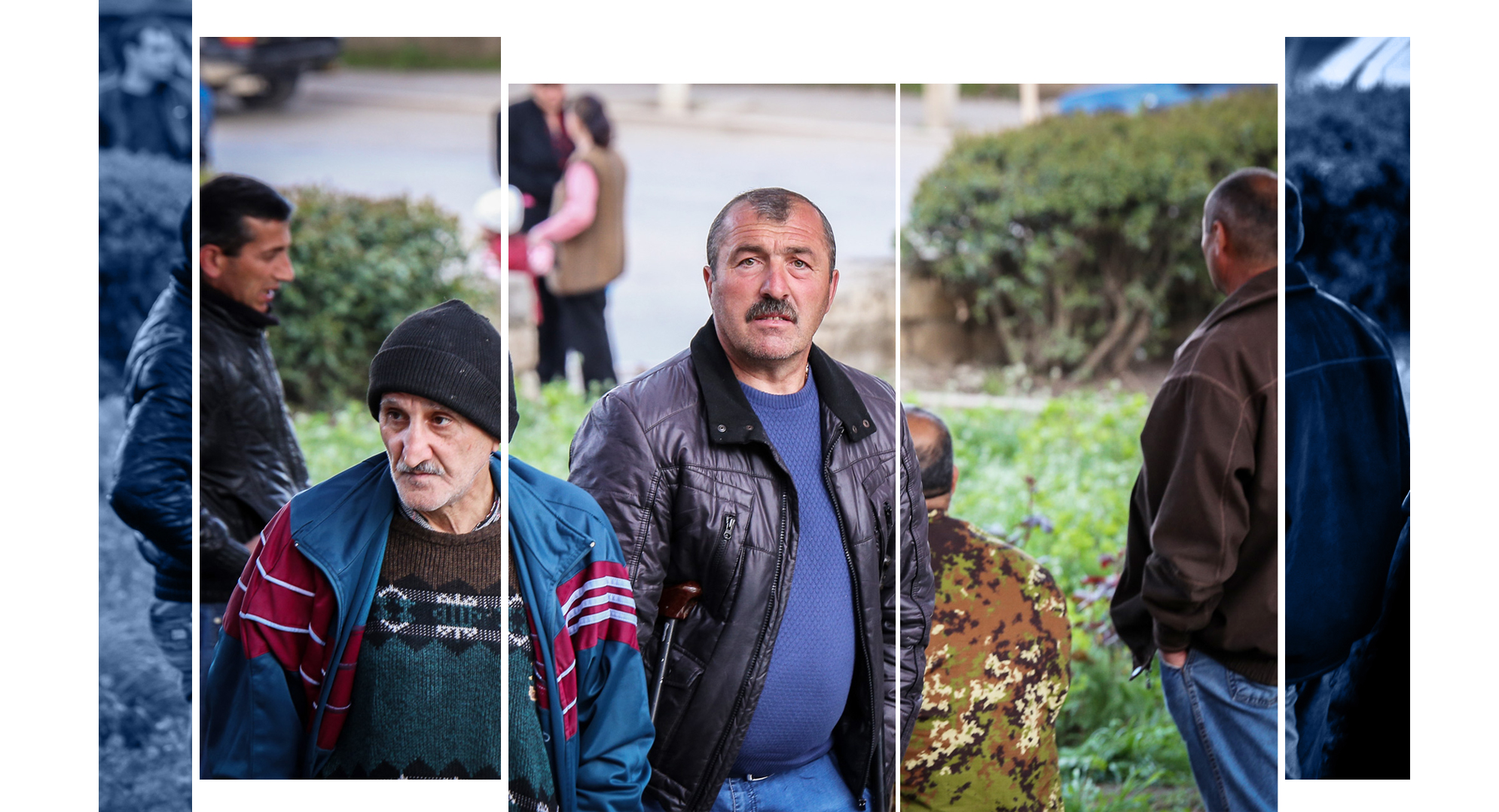
A vote was held following the discussion, and its outcome could come as a surprise to many politicians.
Residents of Ijevan, which borders with Azerbaijan, voted as follows:
29 people voted for maintaining the existing status quo;
27 voted for the independence of Nagorno-Karabakh or its reunification with Armenia;
27 voted for a deferred decision with specific guarantees, which envisages achieving Nagorno-Karabakh’s independence through a referendum.
Nobody voted for the return of Nagorno-Karabakh to Azerbaijan and the determination of the status of Nagorno-Karabakh without specific guarantees.
Here are some of the opinions voiced by the participants during the discussion of the above-mentioned scenarios:
Maintaining the existing status quo
“The status quo is maintained as long as there is no outside interference.”
“If we could maintain the status quo for 50-100 years, that would be the best solution.”
“This option offers no prospects for the development for Armenia and the NKR; we need to take a step and break this impasse.”
“I am a mother, and I cannot bear the thought that tomorrow I will once again be faced with having to send our sons to war.”
Determining the future status of Nagorno-Karabakh
“After the return of the territories, a condition for their complete demilitarization must be set. Of course, they may demand the same from us; maybe we will agree to that?”
“It is wrong to give up Lachin and Kelbajar.”
“The Azerbaijanis will not return after 17-18 years.”
A deferred decision with specific guarantees
“If a compromise is inevitable, then this is the only more or less acceptable option.”
“If we have a defined status and fixed conditions, our security will be more guaranteed.”
A year later, in January 2007, ICHD experts held discussions on five scenarios in Artsakh. A total of 307 people participated (103 in Stepanakert, 116 in Martuni, and 88 in Martakert) in the discussions, and the votes were distributed as follows:
1. Maintaining the existing status quo – 83 votes
2. Nagorno-Karabakh as an independent state – 80 votes
3. Nagorno-Karabakh as part of Armenia – 58 votes
4. Determining the future status of Nagorno-Karabakh; NKR under international protectorate – 2 votes
5. A deferred decision with specific guarantees – 26 votes
6. Other options – 58 votes.
Thus, the scenario which did not envisage a conflict settlement received the highest number of votes, while scenarios more or less similar to those discussed by Robert Kocharyan and Ilham Aliyev received only 28 votes out of 307.
Why did people vote this way? Here are some statements from participants of the discussions held in Martakert, Martuni, and Stepanakert:
“Our government will continue trying to negotiate for a long time, but it is well aware that maintaining the status quo is the best option.”
“I want this situation to continue, I mean, no war. As for whether we are recognized or not is secondary.”
“The status quo suits us better. We have seen that for ourselves. The more time passes, the less hope Azerbaijan will have.”
“Returning the territories is not an acceptable option for us. Returning the territories will lead Azerbaijan to return to its old ways sooner or later.
“If they are ready to recognize our independence, let them do it today; why drag it out for five years?”
“An international protectorate could further worsen the situation. If we rely on external forces, we will lose everything. For now, we are still the victors, and we must defend our victory and our land.”
“The return of refugees is out of the question. If that happens, everything will start over, and we will take up arms again. The problem must be resolved in a way that it does not resurface even centuries later.
“This is not a solution. Even if Aliyev signs it, the next Azerbaijani president will reject it five years from now.”
“The time has come for the entire world to understand that this conflict will not be resolved.”
The last statement, however hopeless it may sound, reflected the sentiments of a significant portion of Arme,nian society. Although not publicly expressed, this was exactly how many Armenian politicians and opinion leaders thought. And it was precisely for this reason that the scenario favoring the maintenance of the status quo prevailed. In other words, “hoping for the best.”

The status quo always led the NKR independence scenario by three votes; people, in a sense, equated the absolute value of independence with the risk of renewed war
The mediators repeatedly stressed the need for political will from the leaders of Armenia and Azerbaijan. Such will was indeed essential. Yet, the truth is, in a situation where Azerbaijan not only failed to curb but actively intensified its anti-Armenian propaganda, it was extremely difficult for Armenian leaders to convince the public that any compromise would not trigger a new war.
Ara Tadevosyan
Photolure, Pan Photo and Agnieszka Pikulicka’s photos are used in this chapter